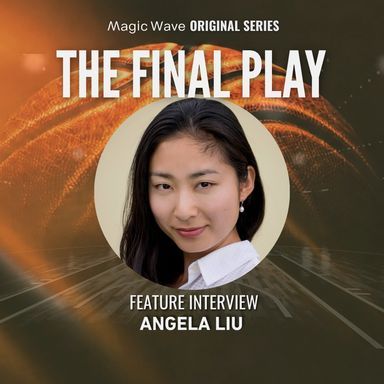
We spoke with Angela Liu, the director of MagicWave’s newest audio drama The Final Play, on how she brought cinematic tension to life in immersive audio storytelling. She dives into what it took to translate intimacy, voice actor performance, and sports into sound. She also shares some tips and tricks for actors looking to get into voice acting.
Interview Details at a Glance
Featured Work: The Final Play
Platform: MagicWave
Interviewee: Angela Liu
Role: Director
Voice Artist: Cayman Cardiff as Leon, Dolph as Miles
Writer: Harlowe Savage
Format: MM / BL Sports Romance Audio Drama
Key Themes: Pride Month, queer romance, athlete pressure, secret relationship, voice acting, immersive audio storytelling
What were your immediate thoughts about the story and characters after reading the scripts?
I thought it was super sweet and I wanted to read more. It was really cute because you don't really see this kind of dynamic and I was kind of expecting the Heated Rivalry type of story, but it's more about the chemistry and the characters in their heads thinking about each other.
What was important to you when preparing for the live recording session with the actors, especially for a BL/MM story releasing this month for Pride Month?
It's always just to learn the intentions of each character and learn the subtext underneath their lines...trying to study the character, imagine what they look like and to think about which lines will have more effort sounds so that we can make the characters [feel] more alive. I've met Cayman before so that was easy. I never met Dolph, but he's also a champ. BL/MM is just like other romance stories. I just like these stories because I like to hear two sexy voices love each other.
As the director, what was it like working with Cayman during the live recording session?
It was my first time working with him. Yeah, he's a pro. He's an on camera actor and I didn't know he did voice acting as well. He actually surprised me because he breathed life into the character. I can hear that he's thinking about his character and is thinking between lines. He's looking for a connection with the other cast member, the other character. He actually knows his character very well.
As the director, what was it like working with Dolph during the live recording session?
For Dolph, I can tell he is not trained as an on camera actor, but I've heard his voice doing the spicy stuff. He's such a champ and he took all the notes. He was very collaborative and he knew how to moan and breathe for his character. At first it was a little bit difficult to match their energies together, but later on he picked up the pace. He was more into the story and the character. Then we gave him more notes and he took all of them and made the character a lot better.
How does directing an audio drama differ from directing a film production or a vertical microdrama production? How is it similar?
The obvious answer is one is voice and one is on camera. With voice acting it's just the voice so you don't have to take care of so many other things like how the performance is on your face, all the actions and [all the] other departments because we only have the actors and the mic and maybe writers in the room. I can just focus on listening to their performance and reading the script. While I was listening I also make notes on my end so I know which [lines] we need to come back and pick up. Directing audio is a lot more chill. You don't have to run around and direct the cast and the crew and go change [into wardrobe]. It is similar because we are all telling a human story. Some of the stories are very similar to microdramas because they're all romance and sometimes a lot spicier than we expected. It is easier because you don't have to think about all the hand movements, the body movements and how to adjust the lights to make it beautiful. You just focus on the performance and the connections between the characters. Both of them are similar because they are both dramatic, romantic and ways for us to escape.
Can you talk to me about the technical parts of voice acting and working in the audio space? How it was in this production?
Being a voice actor helped. I can tell who has been doing audio because they know the distance between their mics and they know about plosives and how to adjust the gains. They know that when they talk they shouldn't move their body too much so that their chairs or the environment make a sound. I have to remind myself of that too. They just needed to adjust how far they should be away from the mic and don't get too loud. Sometimes on Zoom, you have to change your settings so people can hear your breathing, especially for this spicy drama. [You have to] turn on the the original sound (for musicians) so people can hear you. Otherwise, they won't hear that part of your performance. I guess just [advice] for all the actors to update your Zoom so that you have that function.
What is the ideal recording setup for voice actors? What advice would you offer to voice actors from your perspective as both a director and performer?
It's up to the person if it's a long session. I believe most of the voice actors would love to sit down. Some people like to stand up and they have like a standing desk when they record with a higher stool.
Make sure you have a very good mic. Make sure you don't crack your voice. When you're reading your script, your lines, remind yourself what environment you are in, how close you are if you're supposed to be near somebody's face or ear, or maybe you're yelling far away. Maybe you are doing an exercise or maybe you are doing a press release. All these volumes are different and you kind of have to remind yourself how to perform so the audience can hear the space change.
I feel when you're having fun when you're acting that is a good sign that you are actually immersing yourself into the story and this work.
Anything else you'd like to share with us and our listeners?
Listen to MagicWave! Listen to my shows! I have four shows on there. Support human voices and human actors on camera, so we can continue making good stories to connect with each other.
Follow Angela Liu
You can also find Angela Liu’s other MagicWave project here: Days Gone Wild.
To follow Angela Liu’s work beyond MagicWave, visit her Instagram, IMDb, or official website.
To explore the story Angela helped bring to life, read more about The Final Play, MagicWave’s MM sports romance audio drama.
About MagicWave
MagicWave is an immersive fantasy audio platform for listeners who love romantic voice stories, emotional roleplay, fantasy, and intimate sound-led experiences.
From Boyfriend ASMR and M4F audio to MM romance, BL audio drama, spicy roleplay, comfort audios, mature ASMR-inspired stories, and audio erotica, MagicWave creates a private headphone-first space where desire, emotion, and imagination come alive through voice.
Our Originals are made for listeners who want more than a simple story summary. Through expressive voice acting, cinematic atmosphere, sound design, and character-driven storytelling, MagicWave turns romance, fantasy, comfort, and tension into audio experiences that feel close, personal, and deeply immersive.
Whether you are drawn to slow-burn romance, sports romance, queer love stories, fantasy roleplay, soft comfort, spicy audio, or emotionally charged storytelling, MagicWave gives you a space to explore voice acting fandom and discover stories shaped around intimacy, fantasy, and feeling.
The Final Play is one of those stories: a MagicWave Original that brings MM sports romance, slow-burn intimacy, queer romance, and immersive audio performance together in a story about pressure, desire, and choosing love on and off the court. Stream The Final Play, exclusively on the MagicWave app on iOS or Android.